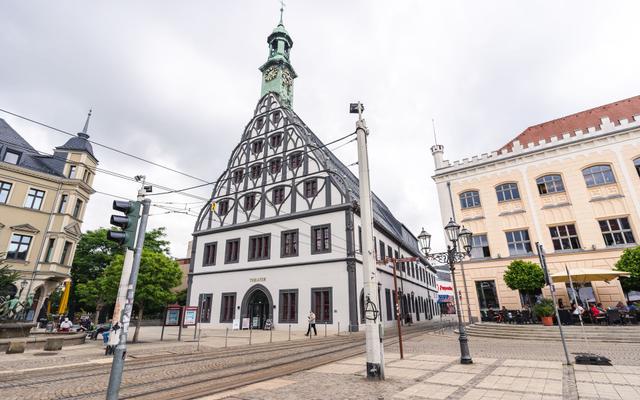
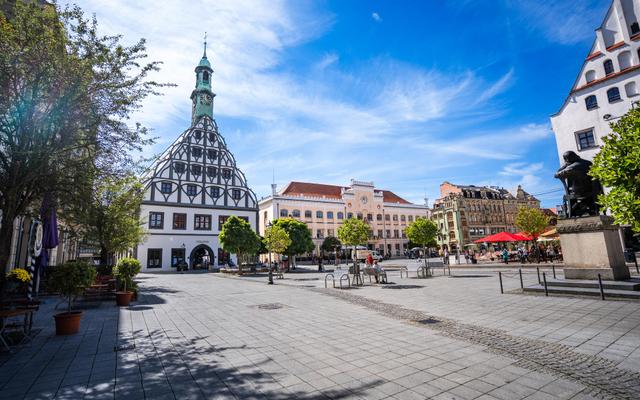
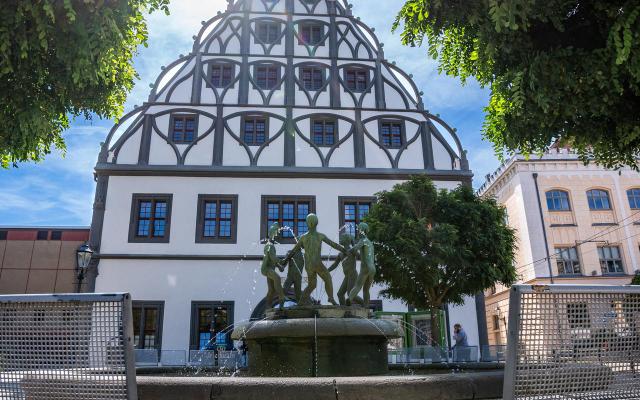
Zwickau
Doctor Henry Jekyll is on the verge of marrying his beloved Lisa Carew. But his own dark side stands in his way. Edward Hyde — born from Jekyll’s self-experiment as his alter ego — was meant to prove that evil can be separated from good. And Jekyll is proved right: evil can be separated. It just cannot be controlled. Freed from every moral restraint, Hyde rampages through London’s foggy alleys — a creature without conscience and without limits. Soon Jekyll is no longer fighting only for his own life, but for the chance to stand at the altar once more as the man Lisa once fell in love with. The evening alternates musically between powerful rock numbers and soulful ballads such as “This Is the Moment” and “Once Upon a Dream” — Frank Wildhorn’s music, already familiar to audiences in Plauen and Zwickau from “King Arthur – Excalibur” and “The Count of Monte Cristo.” More than 1,500 performances on Broadway and productions on numerous German-speaking stages have made “Jekyll & Hyde” one of the most frequently performed musicals of our time. Musical direction Leo Siberski Direction Christina Gegenbauer Set design Isabelle Kaiser Costumes Julia Klug Choreography Gianni Cuccaro Dramaturgy Alexander Busch Chorus master Michael Konstantin With Silke Jahn-Popov, Tamara Köhn, Viktorija Narvidaité, Natalia Willot; Young Chan Cho, Gunnar Frietsch, André Gass, Marian Hadraba, Alexander Jung, Michael Kieslich, Norman Sengewald, Michael Simmen, Andrey Valiguras, Gabriel Wernick, Dietmar Wölker; Opera Chorus and Extra Chorus of Theater Plauen-Zwickau; Ballet of Theater Plauen-Zwickau; Clara
A play by Juan Mayorga | German by Stefanie Gerhold | First German-language production "You should put more names on your mailbox, María Luisa," says the caretaker to her one day. She lives alone in her apartment in the large apartment building, and elderly women living alone are especially at risk of being attacked, surely she knows that. "Hmph, living alone sounds like being lonely, and I’m not lonely at all," María Luisa thinks to herself. Doesn’t she call her friend Angelines several times a day, and don’t they meet every Thursday for coffee and gossip? But all right, then she’ll just write three additional names on her mailbox, men’s names, to be on the safe side. But what if she really did live with these men in her apartment? With Benito Beckenbauer, the fugitive general from Latin America, or Emerson Azzopardi, the shy poet from Malta, or the patient Juan Olmedo, who is always so thoughtful about her pills? With the three new flatmates, she can once again have deep conversations, no longer has to ride the subway alone, and at last there is someone she can go dancing with. But are these men really there? Juan Mayorga is one of the best-known contemporary Spanish playwrights. The Theater Plauen-Zwickau is allowed to present his latest play, "María Luisa," for the first time in Germany, in which Mayorga, as rarely in world literature, makes an elderly lady the central character, who undergoes a thought-provoking and at the same time funny, absurd heroine’s journey. Who says you can’t reinvent yourself in old age? For the premiere in Zwickau, the Madrid-based au
Everything is water, said the Greek philosopher Thales. Heraclitus disagreed: fire was the fundamental substance of the world. Two paradoxical elements, as intangible as they are self-evident. Fire gives warmth, but it is destructive; you can see it, but not touch it. Water is just as paradoxical: take it in your hands and it slips away; without it one cannot live, but masses of water can also threaten our lives. Perhaps the strangest thing of all: they stand in an irreconcilable relationship to one another. Fire drives water into flight and turns it into steam; water extinguishes fire wherever it gets out of control. This conflict was already inherent in Handel's Music for the Royal Fireworks. Written to celebrate a peace festival in London's Green Park in 1749, the celebration became a little too hot when part of the festival architecture caught fire. Fortunately, water rushed to the rescue and fell from the sky to extinguish the flames. Handel had already transformed the power of water into music in 1717, when a single boat with fifty musicians of all kinds played on a night-time river journey in honor of King George I. The king liked it so much that he had it repeated three times on the outward and return journey. To Handel's music, Vanaev now explores these two fascinating elements in a choreography that strings together a series of stirring, fiery and also humorous episodes. Don't worry if Handel's music once again proves too explosive: the dance brings us back to safe harbor. Choreography and direction Sergei Vanaev Stage Johannes Bluth Costumes Sergei Vanaev
Every year, 20 million poinsettias are grown in Germany. One in five houseplants is a poinsettia. But did you know that the red flower originally comes from Mexico? How is Christmas celebrated in Mexico and in Bulgaria? Or in England and Sweden? After exploring the significance of the Star of Bethlehem in connection with German Christmas customs last year, this year we are going in search of Christmas stories, songs, and customs in other cultures. When do people in England actually receive gifts, and why does St. Nicholas come down the chimney? And why is it the one who finds the almond in the Swedish Risgrynsgröt porridge who will be the next bride at the altar? What exactly is a “Surwatschka”? We create small and large moments of hope and togetherness in a variety of traditions and colors. Look forward to new stories and classics, thoughtful and funny poems, a guessing game for the audience, and multi-voice songs in various languages from our actress trio, who are also strong singers. December 1 + 2 + 3 | 6:00 p.m. | Gewandhaus Main Foyer
“Gunpowder is black / Blood is red / The flame flickers golden!” sings the children’s choir. Robert Schumann’s martial song of freedom sounds urgent and pure today. The Revolution of 1848 ignited something in the composer from Zwickau! The idea of a pan-German nation moves many people—and shapes not only the laboriously invoked cultural identity of the Germans, but also Romantic painting, poetry, and music. At the same time, Schumann strives for the heavenly. With his music, he tries to set against all earthly misery—tinnitus, heartbreak, the Frenchman—the “radiance of the truth of art.” A Romantic through and through, Schumann intends to discover the possibilities hidden in reality with playful imagination and curiosity. 170 years after Schumann’s death in the “insane asylum,” we reanimate his era. Starting from Schumann’s work, this world premiere conjures up a Romanticism whose ideals have long since vanished and yet remain present: escapism, longing for primordial nature, and a passion for everything eerie and supernatural. The ensemble and a band of four Schumanns let Romantic motifs and works collide with our present day. The resurrection of Schumann, Novalis, Eichendorff, and Frankenstein’s monster, however, threatens to fail. Fortunately, the children’s choir consoles us over unfulfilled longings. And together with Rosalía, Heiner Müller, and Donna Haraway, they place contemporary Romantics at our side. With them, they invent a new world in which no one will ever again have to be ashamed of being happy. The musical mosaic of Romantic and contemporary fragments w
Boring at the theater?! Not at all! At least not when we’re out and about with the two schoolgirls Hanna and Greta. On a school trip to the theater, they sneak away from their teacher to explore the mysterious building on their own. And lo and behold: behind one of the theater’s creaking doors — the one that promises the least, of all things — Hanna and Greta meet a strange woman: a prompter — or rather, someone who suddenly brings an entire fairy-tale world to life! The two schoolgirls make new, surprising acquaintances — from the reassuring Sandman to the fearsome witch, who… wait a minute. We’re right in the middle of the fairy tale of Hansel and Gretel! And even if the witch is indeed a rather creepy creature, we can rest easy. When the final note has faded away, don’t we end up safely at the fairy tale’s happy ending? This staging of Humperdinck’s beloved children’s opera — based on the famous fairy tale by the Brothers Grimm — brings the story very close to the audience. In an intimate version with piano and with a focus on the central characters — Hansel, Gretel, Mother, Witch, Sandman and Dew Fairy — the production takes all children and the young at heart on a safe journey through hidden doors into the magical universe of opera. Premiere December 13 | 3:00 p.m. | Gewandhaus
Which music makes you dream of Christmas from the very first note? Which melodies do you always enjoy hearing again, and which musical discoveries do you absolutely want to share with others? For this year’s Christmas concert, our choir director Michael Konstantin has put together a personal selection of pieces that particularly inspire him. Alongside familiar and well-loved Christmas carols, there are also a few musical “treasures” to hear—perhaps still unknown, but sure to quickly win your heart. The evening thus becomes a varied journey through festive sounds, familiar classics, and surprising discoveries. At times cheerful and lively, at times calm and reflective—always with that special atmosphere that brings us closer to the most wonderful time of the year. And of course, this year once again includes the popular sing-along songs. Christmas is not just for listening: when many voices sound together, music becomes a shared experience.
“You simply can’t look away. It’s so beautiful,” writes Freie Presse after the successful premiere in 2024. After many sold-out performances in the previous season, Sergei Vanaev’s ballet returns to the stage. You can also admire several new cast members in the ensemble. Pyotr I. Tchaikovsky’s fantastic music transports you to a Christmas setting between reality and fairy-tale world, in which Drosselmeyer pulls the strings. Let yourself be enchanted and get into the Christmas spirit. December 19 + 22 | 7:30 p.m. + December 21 | 6:00 p.m. | Gewandhaus
Book and lyrics: Eric Idle Music: John Du Prez and Eric Idle A new musical, created by lovingly pillaging the Monty Python film “Monty Python and the Holy Grail” | Based on the original screenplay by Graham Chapman, John Cleese, Terry Gilliam, Eric Idle, Terry Jones and Michael Palin | German by Daniel Große Boymann Many legends surround King Arthur. Was he in fact a Celtic-British military leader who won a battle against the Saxons around AD 540, or rather a ruler of the Middle Ages? The British comedy troupe Monty Python, which revolutionized the conventions of television in Britain in the 1970s and 1980s, chose a middle path. In their musical, Arthur is indeed a medieval king, but one who first has to seek out his followers and earn their allegiance. There is, for example, the awkward Sir Bedevere or Sir Galahad, who is actually called Dennis and thinks that kings should be elected. Or Sir Robin, who runs away fearfully from every adventure. By contrast, Sir Lancelot fearlessly fights all the enemies of Camelot at Arthur’s side. Yet he too harbors a secret that he does not want to share with anyone. Monty Python’s knights defy all the usual clichés of glorious chivalry, but when they are given the mission by God himself to find the legendary Holy Grail, nothing and no one can stop them. Not rude Frenchmen, not a bloodthirsty piglet, and not a cruel Black Knight, because at their side is always the powerful Lady of the Lake and, of course, Arthur’s faithful servant Patsy. In 1975, Monty Python released the film “Monty Python and the Holy Grail.” Thirty
05.01.27 - 6 pm: Introductory soirée (free admission) 7 pm: Public rehearsal (free admission) 08.01.27 - 7:30 pm: Premiere followed by a public opening-night celebration An introduction is held at the regular performance times, each time half an hour before the start of the event!
In this curious contest of words, the vibrant poetry slam scene meets and measures itself against its earlier trailblazers and role models, in short, its deceased colleagues. They want to prove themselves once again and, not least, convince the audience: to write clever, funny, exciting, incisive, pointed, emotional, socially relevant, cynical yet hopeful, literary, thought-provoking and above all precisely timed texts that can be read aloud in three minutes — they still do that today, only better. But who can bring the legends back to life on stage with more style? Who can unleash the rhythmic fireworks of language with pinpoint accuracy? Who plays with rhetorical devices and reveals the unexpected layers between the lines? “What they can do, we’ve long been able to do,” thinks our theatre and calls its ensemble together. Of course we accept the challenge! Because in the end, it is still our audience that decides who deserves the honor of applause. The “Dead and Alive” poetry slam evening is an entertaining provocation that encourages engagement with classical and contemporary poetry. Come and see, hear and feel what the art of language has to offer. Cast: Hosted by Philipp Herold Living guest slammers to be announced Dead poets portrayed by the Schauspiel & JUPZ! ensemble
In Jerusalem, different world orders collide across three religions. In the struggle for power in the city, Kurt, a soldier of the bishop, loses faith in being on the right side. Of all people, the Sultana shows mercy! And then there is the daughter of a Jew, with whom he falls in love. Is there even a right side in war? And what does the story that Recha’s foster father Nathan told so often mean? While old conspiracy theories are being retold, radical groups are gaining new support and classic value systems are being called into question, we are searching with Recha and Kurt for orientation in this modern world. Does the Ring Parable also answer today’s struggle for peaceful coexistence? “Nathan’s Children” by Ulrich Hub was awarded the Mülheim Children’s Theatre Prize in 2010. A post-show discussion will follow. Direction Ulrike Sorge Set/Costumes Luisa Lange Dramaturgy Hanna Rüd With Sophia Bauer, Theresa Weidhas; Marius Marx, Philipp Rosenthal, Jörg Seyer Ticket prices: €8.00–19.00
The old Faust is torn apart. Teetering between life and death—worn out by life—his past comes back to haunt him. It is an unreal state in the flickering neon light of a hospital room in which Faust awakens. Does he dream that Mephisto himself sits down on the bed beside him and speaks of the abysses of existence? Are his two younger revenants actually nurses and the senior physician, watching him from their glass booth and observing him as he broods? Or are they his own remorse, his own melancholy? Director Nora Bussenius’s production ventures into in-between worlds: between anesthesia and waking, between an ecstatic spirit world and the banality of everyday desires. A liminal state, then, an impenetrable no-longer-living and not-yet-dying. Set designer Lara Belén Jackel has translated the German tragedy into a sterile white setting familiar to many from their own hospital stays or visits: whoever ends up here, to be healed or to die, finds nothing cozy, but rather an experience that can never be entirely sure of its own truthfulness. So Faust lies there too, at the mercy of himself, his memories, and the will of the medical staff. This early “Faust” version by the young Goethe captivates with its haunting, immediate language. Here the focus is not on the pact with the devil, but on the tragedy of Faust and Gretchen: an impossible love story that must fail not only because of her being underage. Gretchen, still essentially a child herself, desires, loves, and suffers. She breaks out of sex-hostile virtue and social norms and ultimately becomes the murderer of her own chil
20.02.27 - 7:30 pm: Premiere followed by a public opening-night celebration at the Gewandhaus-ThV