Discover concerts, nightlife, dining, culture and events in Bad Bevensen.
Die Schnedesteine sind große Feldsteine mit dem Bevenser Wappen. Sie zeigen alte Grenzmarkierungen um 1700. Bereits im Mittalalter wurden die Grenzen zwischen einzelnen Gemarkungen und Ortschaften gekennzeichnet. Die Steine dienten zur Abgrenzung des eigenen Grundbesitzes oder der Hüterechte für das eigene Vieh. Auch gepachtete Fläche waren damit gekennzeichnet. Im althochdeutschen nannte man das Grenzbeziehen „Schneedgebeziehung“. Das Wort „Schneedge“ wurde für Grenze benutzt. Die Schnedesteine wurden im Juni 2006 an diesen Ortseinfahrten aufgestellt: an der Einfahrt Bevensen-West in der Ebstorfer Straße an der Einfahrt Bevensen-Nord an der Dahlenburger Straße an der Einfahrt Bevensen-Ost an der Röbbeler Straße
On the road to Emmendorf, about 4 kilometres south of Bad Bevensen, you will find a large wooden cross at a particularly beautiful vantage point above the large Ilmenau loop. It is the only high cross of its kind in northern Germany. The Heliand Cross was erected in 1930 and consecrated one year later. It commemorates the Christianisation of the region, which took place between 900 and 1000 AD.<br><br><br>
Bad Bevensen's sundial is located at the entrance to the spa gardens. It is one of the largest in Europe and a highly sophisticated one at that: Since 21 June 1998, the inclined stainless steel mast of the sundial in Bad Bevensen's spa gardens has towered almost 16 metres into the sky, revealing far more than just the position of the sun. Those who take the time are rewarded with a wealth of information about the calendar, seasons, geography and astronomy.<p></p><p>A large round dial on the shadow mast additionally shows the "True Local Time", "Central European Time" and "Summer Time". You can see the length of the day, read off the sunset or the change of the signs of the zodiac. This is why the sundial is also called the "Bad Bevens Observatory of the Earth's Revolutions".</p><p>Here the Earth rotates on its own axis at a speed of 1005 kilometres per hour and at the same time moves on its orbit around the Sun at about 108,000 kilometres per hour.</p><div><p><strong>Almost 16 metre long shadow mast</strong><br>The most important and immediately eye-catching part of the sundial is the almost 16 metre long shadow mast aligned parallel to the Earth's axis. Its tip points to the celestial pole near the pole star. The shadow of the mast moves about 8 centimetres per minute along the outer stone ring path, indicating the rotation of the earth. The shadow of the mast indicates the "True Local Time" at the 15th degree of longitude. This runs through Görlitz on the Neisse River and is defined as the time zone meridian for Central European Time (CET). On the outer circle, red granit
On a barrier-free tour, 14 stations tell of the history and secrets of the spa park. At each station there is a sign with a short description and a QR code, behind which a whole world of further content opens up:<ul><li>a radio play</li><li>Anecdotes and interesting facts about Bad Bevensen</li><li>Tips for relaxation and well-being</li><li>Explanations in easy language</li></ul>The 1.5-kilometre-long tour is barrier-free and connects the stations with each other via paved paths.<br><br><strong>Digital tour with the smartphone</strong><ul><li><a data-cke-saved-href="https://guide.bad-bevensen.en/kurpark" target="_blank" href="https://guide.bad-bevensen.de/kurpark">Directly to the digital tour</a></li></ul><br><strong>Kurpark-Guide</strong><br>Supplementary to the tour there is a brochure with all stations, viewpoints and further information.<ul><li><a data-cke-saved-href="https://www.bad-bevensen.de/fileadmin/Bilder/Info_und_Service/Flyer_und_Brosch%C3%BCren/Digitaler-Kurpark_Flyer_web.pdf" target="_blank" href="https://www.bad-bevensen.de/fileadmin/Bilder/Info_und_Service/Flyer_und_Brosch%C3%BCren/Digitaler-Kurpark_Flyer_web.pdf">To the brochure: Kurpark-Guide - A tour for all senses</a></li></ul>
Since 2011, Bad Bevensen's spa park has had a large wooden pergola and promenade by the lily pond. Wooden benches and wooden loungers invite you to relax and sunbathe and can be adjusted according to the position of the sun.<br><br>The airy pergola takes up the sweep of the spa park and rounds off its landscape form harmoniously with the hotels in the adjacent spa district. The open wooden structure provides cooling on hot days, while the part covered with glass panels collects the sun's heat on cooler days.<br><br>The wide sandstone terraces slope down to the lakeshore and a wooden platform that juts out onto the water. Warm sandstone ashlars border the edges of the terraces and invite people to sit down. Everyone can get everywhere: All levels are connected in such a way that all areas of the spacious complex can be reached barrier-free.<br type="_moz">
The Garden of the Senses in the northern spa park encourages visitors to try things out, touch and look. Various installations playfully train perception and individual senses. <br><br>The individual experience points go back to the insights of the artist, educator and philosopher Hugo Kükelhaus (1900 to 1984). Kükelhaus wanted to give people a concept of reality by perceiving themselves as sensual and feeling individuals. For him, concept was always a consequence of grasping, touching and looking: "It is not the brain that thinks, but the whole person."<br><br><strong>Points of Experience in the Garden of the Senses:</strong><ul><li><em>The Rotating Disc</em><br>If one sets the panel with the black concentric squares and their rounded corners in rotation and concentrates on the black lines on a white background, strange things happen in the viewer's perception: Suddenly it looks as if the lines are undulating around the centre point, alternately contracting and expanding.</li><li><em>The walk-in mirror kaleidoscope</em><br>What we perceive is composed of parts, even if we are not aware of the individual parts. The parts are, so to speak, the original parts of what we see. Seeing therefore means "judging". It is even more difficult to perceive oneself as the sum of different parts. This is what the mirror kaleidoscope wants to help you experience: Anyone who goes inside will see their body from different perspectives at the same time and perhaps come to a different judgement about themselves.</li><li><em>The Little Humming Stone</em><br>Sound waves are not only heard b
Auszeit in der Kirche im Park Erleben Sie eine multimediale Auszeit in der Kirche im Park und begeben Sie sich auf eine Reise zu sich selbst. Besucher sind eingeladen, das Tempo des Alltags hinter sich zu lassen und neue Kraft zu schöpfen – ideal während eines entspannten Urlaubs oder Tagesausflugs. Ob Sie es sich auf der Bank unter dem Sonnensegel gemütlich machen oder durch den Kurpark schlendern, bleibt Ihnen überlassen. Eine außergewöhnliche Reise erwartet Sie: Durch verschiedene Stationen, die zum Innehalten, Lauschen und Nachdenken einladen, erleben Sie eine besondere Zeit im Kurpark Bad Bevensen. Die Audiodateien führen Sie durch folgende Themengebiete: Durchatmen Lauschen Betrachten Da sein Wer bin ich? Woher komme ich - wohin gehe ich? Auszeit an der Quelle des Lebens Medialen Rundgang starten
On a lawn between Medinger Straße and Krummer Arm stands a modern, simple "Memorial of the Returnees". It was erected on 23 November 1953 and was intended to commemorate the then still uncertain fate of many prisoners of war in Soviet captivity.<br type="_moz">
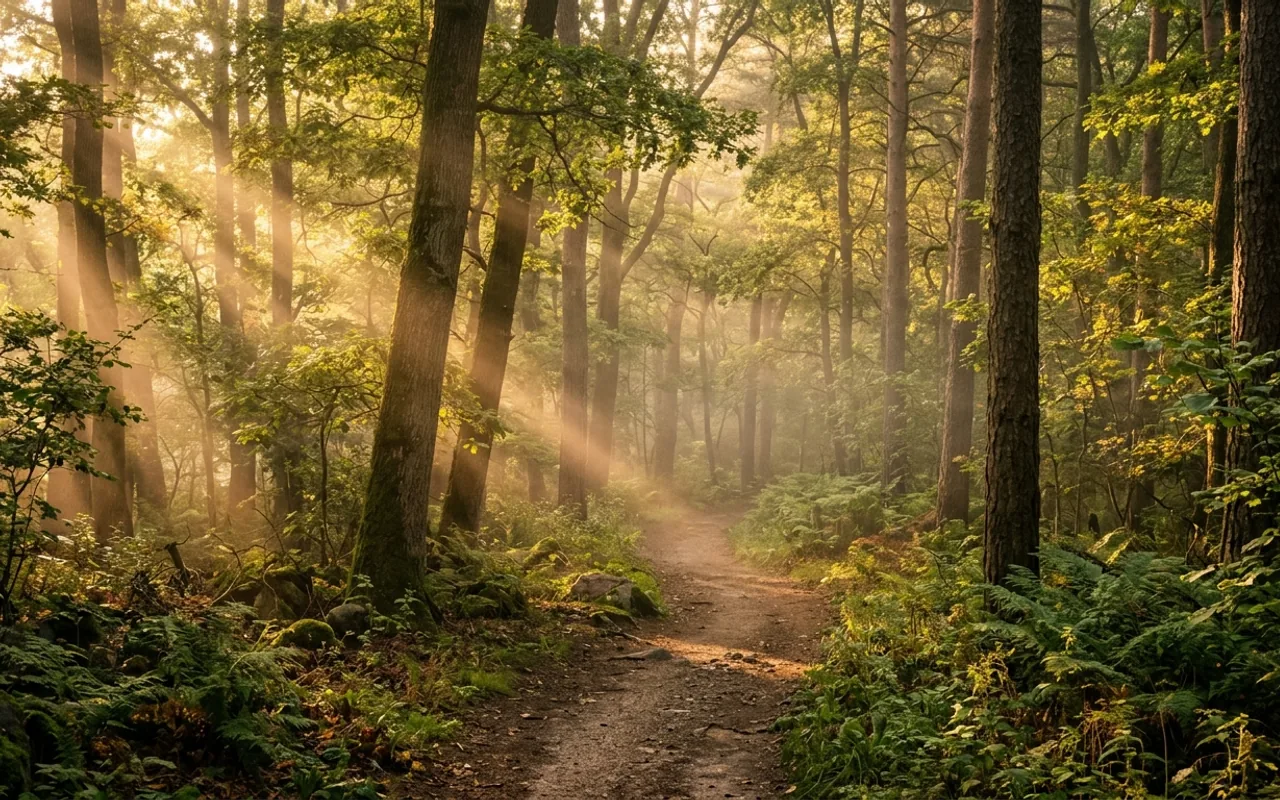
<span>Klein Buenstorf Heath, a small heath area surrounded by pine forests, lies to the south of Bad Bevensen.</span><p></p> <p><span> </span></p> <p><span>The heath is framed by the Elbe side channel and the River Ilmenau.</span></p> <p><span> </span></p> <p><span>Klein Buenstorf Heath reveals itself to the hiker just a short walk from the car park. With a little luck the view may include a horse-drawn carriage or a herd of moorland sheep. Walk across the heath and watch the bees as they collect pollen from the heather.</span></p> <p><span> </span></p> <p><span>Klein Buenstorf Heath lies in a very protected location and therefore blooms slightly earlier than the other heath areas of Lueneburg Heath.</span></p> <p><span> </span></p> <p><span>But there is another special feature on Klein Buenstorf Heath: 59 burial mounds are located on the heath. During the Bronze Age (up to 1200 B.C.), it was customary to bury the dead in simple wood and stone enclosures beneath a mound of earth. The dead were buried together with jewellery, weapons and other valuables. </span></p> <p><span> </span></p> <p><span>The collection of graves in Klein Buenstorf Heath counts among the largest of this kind of cemetery in Lueneburg Heath.</span></p> <p><span> </span></p> <p><span> </span></p> <p><u><span>How to get there:</span></u></p> <p><span>Satnav address </span></p> <ul> <li><span>Klein Hesebecker Strasse, Bad Bevensen, follow the signs and drive to the end of the road or</span></li> <li><span>An den Teichen, Bad Bevensen,
<div><p>At the connection between the pedestrian zone in the old town and the spa park, not far from the Göhrde Bridge in the spa park, lies the Neptune Fountain. It forms a harmonious transition between the urban landscape and the greenery of the spa park.</p><p>The 2.40 m high bronze casting by the sculptor Bernd Maro from Hanover depicts the water deity with trident in playful movement. The water bubbles towards the sculpture in an arc. Two fish - Neptune plays with one, another leaps out of the water - symbolise the variety of water creatures that constantly accompany him.</p><p>At Neptune's feet lies a "sea trumpet", the triton horn. With this curved shell, according to legend, Triton, the son of Neptune, struck fear into the giants in their battle with the gods.</p></div><div><div><div><div><div><div></div></div></div><div><p>In his outstretched right hand Neptune holds the "Tridens". The trident stands for lightning, which the sea god is said to have once hurled as a rival to the king of the gods. On his wild rides across the sea, he uses it, depending on his mood, to stir up or smooth the waves.</p><p>Around the fountain, a wrought-iron pergola, which also forms a kind of gateway between the spa park and the city, invites visitors to sit and rest by the splashing water.</p></div></div></div><strong>Neptune</strong><br>The figure of Neptune was chosen with care. For the Romans, Neptune was the god of springs and rain. But when the Romans had to build up a fleet in the 1st Punic War (264-241 BC), they lacked a sea god. Without further ado, they equipped their freshwat
Ein Ort zum Wärme tanken im Kurpark Bad Bevensen Die Sonnenfalle ist ein besonderes Gebäude mitten im Kurpark von Bad Bevensen - hier können Besucher des Kurparks zu jeder Jahreszeit Wärme tanken. Der ca. 60 qm große Raum ist auch für Rollstuhlfahrer erreichbar und bietet im Winter wie im Sommer einen warmen Rastplatz. Blick in den Kurpark Die große Fensterfront gibt den Blick in den weitläufigen Kurpark frei und speichert die Sonnenstrahlen in einer Lehmmauer. Bei schönem Wetter ist die Fensterfront geöffnet. Besucher können das ganze Jahr über Wärme tanken, der Bereich ist wind- und wettergeschützt. Das Gebäude liegt in direkter Nachbarschaft zu den Freibecken der Jod-Sole-Therme und des Kurhauses. Bequeme Sitzgelegenheiten Innen laden hochwertige Sitzmöbel zum Aufenthalt ein. Und auch auf der Terrasse um die Sonnenfalle können Besucher auf drehbaren Holzstühlen und Holzliegen entspannen und dabei den Ausblick in den Kurpark genießen. Wie funktioniert die Sonnenfalle? Die durch die Fensterfassade einfallendenden Sonnenstrahlen werden in dem Glasbau von einer Lehmmauer gespeichert. Die lange Lehmmauer zieht sich auch außerhalb des Gebäudes weiter. So hat sie genügend Fläche, um tagsüber reichlich Sonnenwärme aufzunehmen und in das Gebäude abzugeben. Bei schönem Wetter öffnet sich die Fensterfassade der Sonnenfalle über die ganze Front - so wird die Wärme reguliert.
In the middle of the Klein Bünstorfer Heide there is a granite boulder weighing about two tonnes. Since 28 August 1966, the boulder has commemorated the heath poet Hermann Löns, whose name is carved into the stone. The large erratic block was transported from the place where it was found in the district of Soltau to Klein Bünstorfer Heide by the German Armed Forces to mark the 100th anniversary of his birth.<br><br>There are wooden benches at the Löns memorial stone, inviting visitors to take a rest on Klein Bünstorfer Heide.<br type="_moz">
Justus Wilhelm Lyra, born in Osnabrück in 1822, was a pastor and composer and worked in Bad Bevensen for several years. He composed his best-known song "Der Mai ist gekommen" (May has come) here as well as around 40 other songs and motets during the period from 1869 to 1877, when he was pastor in Bad Bevensen. Since 1901, various choirs have sung the May classic every year on 1 May in the Kurhaus together with guests.<br><br>In the Kurpark, a bust next to the music shell commemorates the musical pastor. It was unveiled at the May Festival in 1995.
Discover 13 curated Nature & Outdoor events and highlights in Bad Bevensen on Viventii with times, venues, and tickets. Current highlights include Schnedestein Bevensen-Nord, Heliandkreuz, Sonnenuhrgarten Bad Bevensen.
Viventii currently lists 13 public events, concerts, parties, cultural happenings, and local spots in Bad Bevensen, including Schnedestein Bevensen-Nord, Heliandkreuz, Sonnenuhrgarten Bad Bevensen.
Use Viventii's curated Today, Tonight, Weekend, This Week, Leisure, and Places guides for Bad Bevensen.
Yes, browse free admission events at /en/cities/Bad Bevensen/free and 0% fee tickets at /en/cities/Bad Bevensen/tickets.