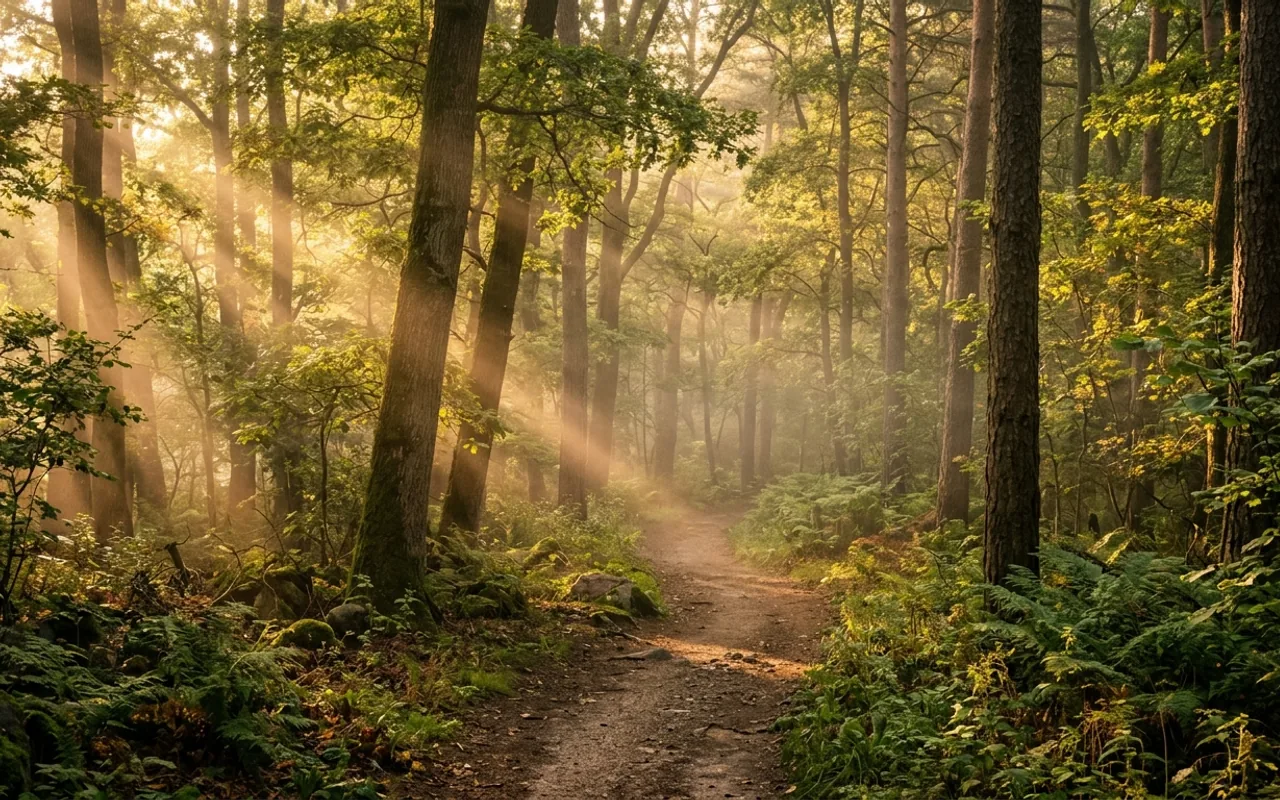
Discover concerts, nightlife, dining, culture and events in Calw.
The best views of Calw are offered by the new panoramic walkway in Calw’s city garden. A stroll with a wow effect: the new panoramic walkway in Calw’s city garden invites you to discover the town from a completely new perspective. Stretching for around 150 meters, the elegant wooden walkway leads across the city garden—past old trees and on to two viewing platforms with breathtaking views of Calw. Whether you’re strolling along, lingering on the seating steps by Lärchenweg, or pausing on the platforms, nature, architecture, and views come together here to create a special experience. Made from oak and Douglas fir wood, the panoramic walkway combines sustainability with design—a place to take a deep breath, marvel, and enjoy. Come by and experience Calw at its most beautiful—high above the rooftops, close to nature. Facts: The wooden walkway is 150 meters long. There are two viewing platforms and seating steps at the entrance to Lärchenweg. The primary supporting structure, with its approximately 160 foundations, was made of oak wood. The flooring of the platforms and the railings are made of Douglas fir.
The Wurstbrunnen Valley is about the water supply of that time. A Wurstbrunnen is first mentioned very late, not until around 1680. The unusual name arose through numerous misspellings of the term Urspring. In fact, there were several springs that fed the Wurstbrunnen. The Wurstbrunnen lies above Castle Hill, where Calw Castle once stood. From there, the springs supplied the suburb below Castle Hill. It is likely that Calw Castle and the city’s “nucleus,” the craftsmen’s settlement below the castle, also received their water from here. The water from the Wurstbrunnen was also carried on into the town center. Only in the second half of the 19th century did the town receive a modern water supply with metal pipes and elevated reservoirs. In the 20th century, the city’s water demand increased enormously, so that additional, more distant springs had to be tapped and pumping stations built. Even today, however, much of the water in the town of Calw comes from springs within Calw’s municipal area, just as the water for the castle of the Counts of Calw once did. Near the Wurstbrunnen, on the land of the former independent municipality of Alzenberg, there was a tunnel centuries ago in which crystallized quartz was extracted.
On Schillerstraße, you can learn facts and figures about Calw's city history. Great panoramic view.
We leave the city garden by the Georgenäum and turn right toward Schießberg. We take a closer look at the wall belonging to the Georgenäum in this area. You can spend hours here and still not have discovered every little plant, every bit of moss, every tiny spider, every little beetle. Walls are fascinating ecological habitats. Even in the city center, they can come very close to the corresponding natural biotopes, the small-scale rock formations. Factors that decisively influence biodiversity include the size and location of the wall (sunny or shady; damp or dry), as well as the surface (rough or smooth), the base material (limestone or silicate), and the pointing (mortar- or concrete-pointed or unpointed) of the stones used. From an ecological point of view, walls made of unpointed natural stone (so-called “dry-stone walls”) in a very damp or very dry location are ideal. The biodiversity that can be discovered on walls is remarkable: algae, mosses, lichens, ferns, grasses, or flowers sprout from cracks in the wall; small creatures such as millipedes, spiders, woodlice, earwigs, beetles, flies, harvestmen, wasps, bumblebees, and even lizards, snakes, fire salamanders, birds, common toads, and mammals such as bats, shrews, and other mouse species find a habitat there. Experience the environment and nature Listening - Walls create boundaries, as you can clearly hear. They amplify the sound of the place and screen out the background. Seeing - Take your time with your journey of discovery; it takes a while before the right way of seeing sets in. Touching - Wall habitats i
This time we are meeting in front of Calw Town Church. Here once stood a lime tree planted in 1830, which unfortunately had to be felled because of a fungal disease. The little tree replanted in spring 2011 will have to grow for 170 years before it achieves the climate performance of the felled lime tree. What do you think: how many animal and plant species can be found around the church? Some people have found more than 40 species here in a short time. Compared with most natural biotopes, a city is a rather extreme biotope, says the biologist. The individual habitats are small-scale, short-lived, and far apart. Extreme living conditions often prevail, sometimes to the point of being considered decidedly hostile to life. In addition, cities cut through and isolate large-scale habitats; polluted, warm air, light, and noise also have a negative impact on the surroundings. Nature conservation therefore makes sense especially in inner-city areas. Preserving life-giving niches in buildings and trees reduces the isolation of habitats. The Town Church is a good example of this. Even the church tower has its inhabitants. It offers a good overview, is far enough away from people, and is an ideal starting point for foraging flights into the surroundings. Climate performance The old lime tree before it was felled. A tree of this size - produces the daily oxygen requirement for 12 people - processes 500 liters of water per day - filters 750 kg of dust per year, which can account for up to 80 percent of the dust in the air - removes up to 300,000 kcal of heat energy from the surro
In this tent of stone, a musician is said to have once lived. The musician played the violin and did not have the money to afford an overnight stay at the inn, so he used the stone as shelter.
Gimpelstein, a massive rock formation high above Calw, belongs stratigraphically to the Conglomerate Sandstone Formation (SMG) of the Middle Buntsandstein. It is a large table-shaped rock formation, heavily fractured and, due to differently hard sections of the rock, with overhangs and niches. Cross-bedding and other sedimentary structures are clearly visible. From the rock formation, there is a wide view over Calw and the Nagold Valley.
The small grape hyacinths can be found in the Calw nature reserve, in the Holzbronn district. Here they are affectionately called Träublehyazinthen. The largest populations of the small grape hyacinth are located in the districts of Holzbronn and Gültlingen in the "Gültlingen and Holzbronn Heaths" nature reserve. Around 200,000 plants can be admired here in spring in April/May.
Viewing platform on the top platform of the tower with a magnificent view of Calw. If you arrive by the Hermann-Hesse-Bahn, you will come directly onto the path to the staircase and towards the elevators to the viewing platform. If you come from below, you can conveniently use the elevators to reach the viewing platform. From up there, you have a wonderful view of Calw with its half-timbered old town, the Nagold, and the city garden with panoramic walkway, as well as the Black Forest behind it.
The nature reserve for animals and plants consists of 18 island-like nature reserves, which are enclosed and connected by three landscape conservation areas. In total, it covers 885 hectares, of which 301 are under nature protection and 584 under landscape protection, spread across the town of Calw as well as the neighboring municipalities of Althengstett and Gechingen. Within Calw’s municipal area, there are mainly three areas: the small wooded area between Heumaden and the railway line, the area with Doma and Winkeltal south of Stammheim, and an area that encloses Stammheim to the east like a bracket.
Meistersberg with a splendid view of Calw and Castle Hill. Here, the history of the Counts of Calw with their castle comes to life.
Beautiful view of Weltenschwann and Speßhardt. At the water reservoir on Schwarzwaldstraße, Heerweg between Spindlershof and the campsite. At the water reservoir on Schwarzwaldstraße, Heerweg between Spindlershof and the campsite.
At the Weinsteg, information is provided about the Rafting and Trading Company. At least since the 14th century, weaving, fulling, dyeing, and combing were carried out in Calw and the surrounding area - cloth production in Calw has a long tradition. Through a state-moderated agreement between the Calw dyers' guild and the guilds of cloth makers in the town and surrounding area, the Calw Cloth Trading Company (CC) was founded in 1650. The head of the Rafting and Timber Trading Company was Johann Martin Vischer. The dissolution of the Calw Cloth Trading Company, which had existed since 1650, in 1797 was the result of long-term developments as well as short-term events. The woolen cloth, which had brought prosperity to the town for 150 years, no longer matched fashionable taste and, because of outdated production methods, was too expensive and therefore no longer competitive. The cheaper cotton fabrics quickly conquered the German market, and the restrictions of Napoleonic policy made access to the northern Italian markets, which were extremely important to the Company, more difficult. But the strict separation between production and sales, as envisaged by the moderation agreement, had also become outdated. 1796 the partners (Company associates) agreed to ask the duke to dissolve the moderation agreement, which he granted in March 1797. Company associates from the Schill and Wagner families took over the properties and founded two successor companies under the company names Wagner & Co. and Schill & Co.
The nature reserve for animals and plants consists of 18 island-like nature reserves, which are enclosed and connected by three landscape conservation areas. In total, this covers 885 hectares, of which 301 are under nature protection and 584 under landscape protection, spread across the town of Calw and the neighboring municipalities of Althengstett and Gechingen. Within Calw’s municipal area, there are mainly three areas: the small wooded area between Heumaden and the railway line, the area with Doma and Winkeltal south of Stammheim, and an area that encloses Stammheim to the east like a bracket.
The Nagold rises from a spring near Urnagold (municipality of Seewald) and flows into the Enz in the center of Pforzheim. Significance in the "Living with Water" flyer: The Nagold rises from a spring near Urnagold (municipality of Seewald) and flows into the Enz in the center of Pforzheim. The Nagold is 92 kilometers long and has a catchment area of approx. 1,150 square kilometers. It has always been of great importance to Calw: it supplied drinking water for people, animals and plants, washing and utility water for households, and many pre-industrial and industrial businesses such as tanneries. In the past, the Nagold used its water power to drive mills and sawmills; today, generators produce electricity. The Nagold also plays an important role as a habitat for animals and plants. The most important tributaries are the Waldach, Teinach and Würm. Hydropower from the Nagold A run-of-river power plant located above the Nikolausbrücke in the center of Calw generates electrical energy. The water of the Nagold drives a generator with an output of 220 kilowatts (kW) via a Kaplan turbine. This produces one million kilowatt-hours (kWh) of electricity annually without carbon dioxide emissions. The newly built power station building also houses the switchgear for Calw's power supply. Remarkable: electric light first came on in Calw's houses in 1910. Significance for the Literary Walk: During Hesse's youth, the Nagold was dammed almost continuously within the town area so that millers, craftsmen and factories had water power. Along the banks, the tanners, after whom Hesse gav
Our route takes us from the Lower Market Square up through Salzgasse and Stadtgarten to Schillerstraße. There we turn right and, after a few meters, reach the "Hundred Stäffele." The Black Forest lies behind us, the town in front of us. On the horizon on the other side of the Nagold, the Muschelkalk slopes of the Heckengäu can be seen. At this spot, alongside the local climate-maker Stadtgarten, we demonstrate Calw's climate in its overall context. From a climatic point of view, cities are heat islands. Buildings slow down the air and bring it to a standstill. Over bare surfaces, the balancing factor of water is quickly used up. Heat sources from people, such as engines and heating systems, also contribute. Warm, stagnant air has major disadvantages: the oxygen content decreases, while the proportion of dust and pollutants increases. So cold air is needed. However, Calw's location in the narrow valley, across the main wind direction, makes the supply of fresh air more difficult. The forests in the surrounding area have an important filtering and air-exchange function. They exchange used, CO2-enriched air for fresh, O2-rich air. But this is not enough for circulation into the town center, because the forests do not cool the air sufficiently. Meadow and field areas are better suited for this. They release most of the heat absorbed during the day at night. For the heavier cold air to flow down into the valley, open areas on slopes are therefore necessary. Climate protection: Think globally - act locally Periods of drought, floods, storms - most climate researchers agree tha
Here you can see the popular Disney film character "Olaf" from the film "Frozen".
The Nagold Riverside Path (along the Nagold from Market Bridge to Lower Bridge) was created in 2002. It opens the city toward the river and invites visitors to stroll along the water. The Nagold is 92 kilometers long. It rises in the Northern Black Forest and flows into the Enz in the center of Pforzheim. From its source near Urnagold (municipality of Seewald), it first flows eastward until it turns north in Nagold. From there on, its valley roughly forms the eastern boundary of the Black Forest. Its most important tributaries are the Waldach, Teinach, and Würm. Like the Enz, the Nagold was of great importance for rafting in earlier times. In the Footsteps of the Raftsmen As early as the Middle Ages, the Nagold became an important trade route and the lifeline of the Northern Black Forest. The abundant timber of the Northern Black Forest was rafted via the Nagold, Enz, Neckar, and Rhine as far as the Netherlands. Only with the construction of the Nagold Valley Railway in 1868–1874 and the expansion of the state road from Calw to Pforzheim did transport shift to road and rail. In 1911, the last raft traveled down the Nagold. The Raftsmen's Museum in Unterreichenbach still bears witness to this cultural era.
In the distance, Hirsau Monastery can be seen. Just a short distance downstream along the Nagold, the oldest ancestors of the Counts of Calw are said to have founded Hirsau Monastery in the 9th century. According to legend, it was Count Erlafried and a relative of the count, Noting, Bishop of Vercelli (northern Italy). The monastery was built for the salvation of souls, and the monastery church was intended as a worthy and fitting burial place. The Aurelius Monastery existed until around the year 1000; after that, the small Romanesque monastery, which housed the remains of Saint Aurelius, fell into ruin. In 1049, Pope Leo IX demanded that his nephew, Count Adalbert II, rebuild the dilapidated monastery. In 1059, he began the reconstruction. After some initial difficulties, the Benedictine monastery flourished under Abbot Wilhelm. Since this second Aurelius Monastery was far too small for the thriving monastic life, Abbot Wilhelm had a considerably larger new monastery built on the other side of the Nagold, dedicated to Peter and Paul. At the beginning of the Investiture Controversy, Hirsau sided with the Pope. The Hirsau monastic reform, which many other monasteries joined and which led to the founding of several monasteries, sought a return to the origins, to the Rule of Saint Benedict, and to a simple and clear monastic life. This monastic reform was inspired by the French monastery of Cluny. When the Reformation was introduced in Württemberg in 1534, most monasteries and their possessions fell to Duke Ulrich in Stuttgart. In Hirsau and 15 other monasteries in Württember
The visitor center of the Special Forces Command (KSK) invites visitors to learn and exchange ideas. The publicly accessible exhibition on the history, mission, and people of the KSK offers first-hand insights for the first time. Directly in front of the heavily guarded entrance to Graf Zeppelin Barracks in Calw, there has recently been a modern, plain wooden single-story building. Large metal letters spell out “Kommando.Spezial.Kräfte Visitor Center.” The building is a public meeting place that is free of charge and barrier-free. Presented in exhibition form, this unique Bundeswehr unit offers a wide range of facts about its origins and development up to the present day. Largely unnoticed by the public, mainly regional companies built the new building in a record time of twelve months. In this respect, the project fits the special forces well, whose characteristics include inconspicuousness and speed. The members of the Special Forces Command, often referred to as “silent professionals,” are thus deliberately stepping into the public spotlight. For the first time, it is possible to obtain comprehensive first-hand information about this Bundeswehr unit on site. The basic aim is to show the greatest possible transparency, insofar as security allows. This is intended to dispel clichés and myths. In three main sections, visitors learn more about the people, structures, tasks, and equipment of this unique Bundeswehr unit. The keywords Command, Special, and Forces designate the corresponding exhibition sections. Numerous aspects of the eventful history of the KSK, spanning mo
Metal sculpture in the city garden next to the Georgenäum. Artist: Karl-Heinz Franke, Unterhaugstett Unveiling date: 2004 Project: "Tatort Kunst" Location: city garden next to the Georgenäum Material: metal
The Naturpark-AugenBlick is a very special viewpoint that you should definitely discover. A breathtaking and all-around beautiful view awaits you. Every AugenBlick is equipped with a bench, a small table, and a labeled panoramic display. The design is based on the nature park “eye,” our logo. The AugenBlick is part of the Naturpark-AugenBlick-Runde Holzbronn
The Hohe Fels gets its name from its location, high above Calw on Kapellenberg. The stone slabs look like fingers pointing west. The arrangement of the stones is not natural; it is believed that the Celts once intended to build a wall there with the slabs. A few meters next to Hoher Fels lies a stone block 3 meters long, 3 meters wide, and 1.5 meters high. It looks like a fish’s mouth, hence the name.
In the area of the former cloister behind Aurelius Church, a herb garden with native medicinal herbs was created based on medieval models. In 37 beds, visitors will find around 50 different plant species, including examples from “Walahfrid’s Herb Garden” and the “Medicinal Treasury of Hildegard of Bingen”. Herb Gardens in the Middle Ages Creating a herb garden was of great importance to the monks. Not only was physical labor given great significance alongside spiritual work in the form of “ora et labora,” but the garden also served both economic sustenance and contemplative reflection and the edification of the soul. Monasteries became a haven of scholarship at an early stage. Ancient authors were also part of the monks’ education. With knowledge of the healing powers of herbs, the foundations of the healing arts were laid with plants that remain valid to this day. References to Hirsau Monastic History The famous St. Gall Monastery Plan (c. 826) already refers in the “Herbularius,” the herb garden, to 16 medicinal herbs. As an ideal plan for Benedictine monasteries, it became the model for a monastic complex, including the monastery on Reichenau. Here, under Walahfrid Strabo (808–849), abbot of the Benedictine monastery, the exemplary medieval herb garden, the “Hortulus,” was created. His instructional and laudatory poem “De cultura hortorum” (On the Cultivation of Gardens), written in 444 verses, describes 23 plants, the work in the garden, its hardships and blessings, as well as the virtues and effects of individual herbs and vegetable plants. Walahfrid Str
Stones are a real treasure trove for us track detectives. What stories could these stones tell? Many of them may even have experienced the dinosaurs “live”! This station takes us to the Central Bus Station (ZOB), high up on the top parking deck. There you can enjoy a magnificent view of the town. Behind you (to the east) the Upper Gäu rises up; below and in front of you lie the Nagold Valley and the town. Beyond that (to the west) the Black Forest spreads out. The Nagold flows north — from your point of view, that is to the right. Towns are artificial rock landscapes. The variety of rock types used can reach considerable dimensions. Among natural stones, three major categories are distinguished. Sedimentary rocks are formed by the slow deposition of fine particles such as sand or limestone and are recognizable by their more or less pronounced layering (examples: Buntsandstein, Muschelkalk). Igneous rocks are formed by the cooling and crystallization of molten rock and make up the majority of the solid Earth’s crust (examples: granite, basalt). Under pressure and heat, rocks are transformed and recrystallized into metamorphic rocks (examples: gneiss, slate). They are often recognizable by foliation. Artificial stones, which are produced by industrial processes (examples: concrete, asphalt, clay), are of great importance in modern urban construction. Ecologically relevant criteria in material selection include production, extraction, transport, durability, reusability, but also landscape aesthetics. Three major categories are distinguished among stones: - Sedimentary rock
Hermann Hesse exhibition focusing on "Hermann Hesse's childhood in Calw" and "Calw in the works of Hermann Hesse". The building of the Weißgerberei Balz was erected around 1800 on the banks of the Nagold and provides information about the tanning tradition in Calw. Like no other trade, this craft shaped Hermann Hesse's childhood and youth. It is therefore no wonder that in his stories he gave his hometown the code name "Gerbersau," whose cycle of stories offers important insights into the life of a Swabian small town. Based on numerous exhibits such as manuscripts and photographs, the museum's front building traces Hesse's childhood in Calw as well as the processing of these experiences in his literary works. Hesse's grandfather Hermann Gundert, the linguist who remains important to this day, also made a decisive contribution to shaping his grandson, and is presented in more detail as well.
Please note: The Hermann Hesse Museum is closed until 2027 due to renovation and conversion work. As an alternative, you can visit the presentation on Hermann Hesse in Palais Vischer, which provides an overview of the poet’s stages of life as well as his work as a painter in his adopted home of Montagnola. In addition, two rooms focus intensively on the theme of the novel "Steppenwolf." At the Tannery Museum (front building), there is also a Hermann Hesse exhibition with the focal points "Hermann Hesse’s Childhood in Calw" and "Calw in the Work of Hermann Hesse." The digital exhibition "Steppenwolf and Painter Friend. Gunter Böhmer Illustrates Hermann Hesse" shows the close friendship between the two artists and presents the special edition of Hesse’s "Steppenwolf," illustrated by Gunter Böhmer, with numerous drawings. The Hermann Hesse Museum opened in 1990 in the historic city palace "Haus Schüz," overlooking the poet’s birthplace. It features the most extensive collection on the Nobel Prize in Literature laureate of 1946, born in Calw on July 2, 1877, and the world’s most widely read German-language author of the 20th century.
Let us embark on a journey of discovery through the city’s kitchen gardens. If we now walk down the "Hundert Stäffele" from Schillerstraße into the "Zwinger," we see the diversity of a garden landscape that has grown over generations, with its ecological niches. Alongside tomatoes, beans, and Chinese runner ducks, there is also ideal habitat here for wild animals and wild plants. The area between the last steep foothills of the Black Forest and the densely built-up core zone is shaped by the kitchen gardens of the people who live here. This extraordinarily diverse structure, with its many small niches, has a special appeal. The climate here is highly localized. Walls that warm up quickly, together with lawn and bed areas as well as shrub and tree structures, create a fairly balanced situation in a small space. Shade and light are distributed—people and animals can each retreat to the “corner” most pleasant for them. Biological diversity is also distributed in a mosaic pattern. Species counts in these kitchen gardens can reach considerable dimensions. Alongside insects (beetles, cicadas, ants, bugs) and spiders, it is above all the birds that find their niches here. Nest boxes can make a valuable contribution not only for birds, but also for insects. But mammals such as hedgehogs, wood mice, shrews, squirrels, and stone martens also feel extremely at home in such gardens. Numerous birds such as the friendly robin, tits, or the loud wren feel just as at home in the kitchen gardens—as long as chemicals are avoided—as cultivated and wild plants do. In Calw, two major grasshop
Discover 36 leisure activities, outdoor spots, sports, museums, and workshops in Calw for today or this weekend. Current highlights include Wooden rabbit figurine with baby rabbit, Panoramic Walkway in Calw’s City Garden, Welzberg Hut viewpoint.
Explore 36 leisure activities across outdoors, sports, exhibitions, workshops, and cinema in Calw, such as Wooden rabbit figurine with baby rabbit, Panoramic Walkway in Calw’s City Garden, Welzberg Hut viewpoint.
Open our places and attractions guide at /en/cities/Calw/poi for opening hours and addresses.
Yes, visit /en/cities/Calw/kinder for curated kid-friendly outings and family workshops.