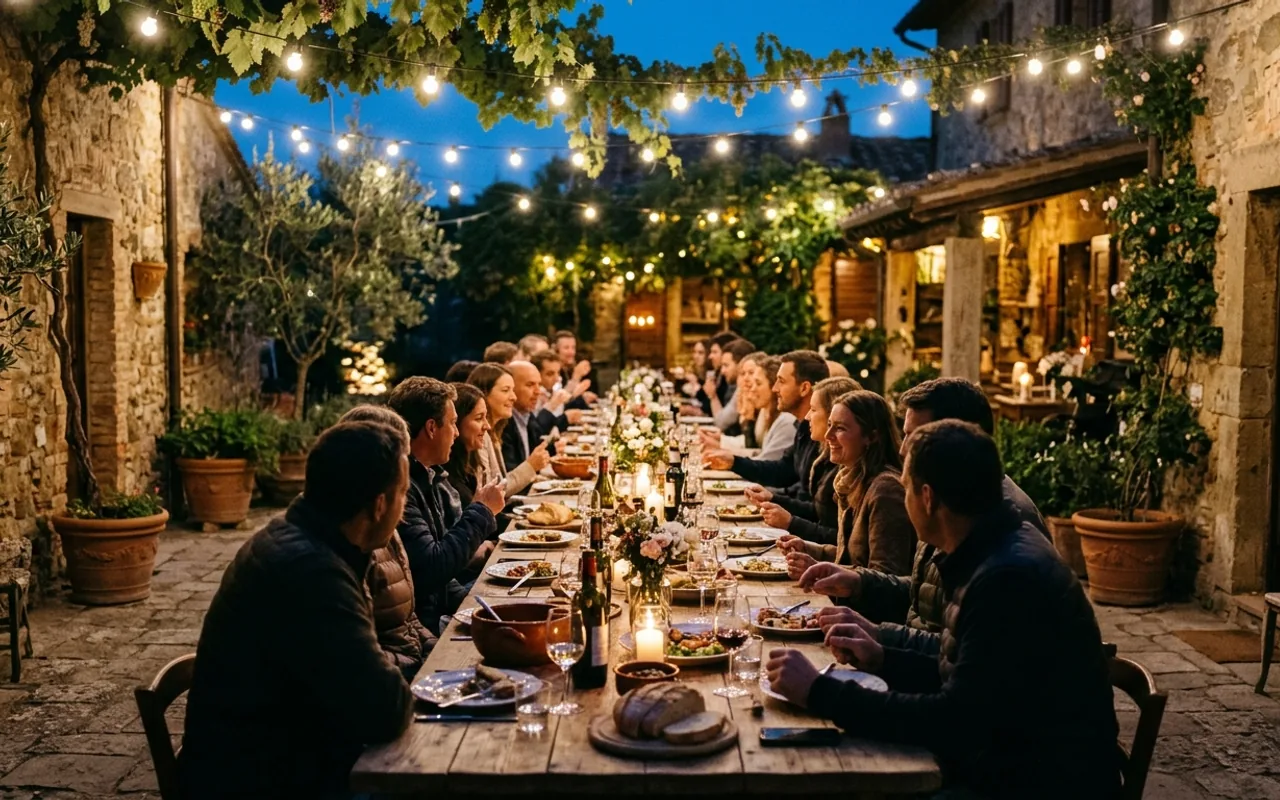
Discover concerts, nightlife, dining, culture and events in Greding.
The two side altars come from the Jesuit church in Eichstätt and were purchased in 1735 for the parish church in Greding. The original altar was removed at the end of the 19th century and replaced by the present high altar, which was acquired after secularization from Rebdorf Monastery near Eichstätt. It dates from the early Rococo period around 1735 and is probably a design by the Eichstätt court sculptor Matthias Seybold. The high altar painting by the Augsburg painter Johann Georg Bergmüller shows St. James kneeling in prayer before the Holy Trinity. In the background of the painting, a partial view of the town of Greding can be seen. The two side relief figures depict St. Crispus and Crispinian. The approximately 2.50 m-high Stations of the Cross paintings in carved Rococo frames were painted in 1741/42 as votive offerings on the occasion of a plague raging in the town. The ceiling paintings date from 1875. St. James's Church was renovated in 1971/72 and fitted with a new organ in 1976.
In 1633, however, this building, together with several residential houses, was set on fire by Swedish soldiers in order to extort 1,000 Reichstaler from the townspeople. The present Town Hall was probably built in 1699 by the Eichstätt court master builder Jakob Engel. Embedded in the facade is the coat of arms of the then lord of the town, the Prince-Bishop of Eichstätt, Johann Martin von Eyb (1697–1704).
The residential building is a two-story Jura house with eaves-facing orientation, a knee wall, and formerly a limestone slab roof. It is entered from the gable side and still has historic cross-mullioned windows. Set into the facade are the coat of arms of Prince-Bishop Johann Euchar Schenk von Castell and the date 1686. In 1692, the medieval parish church was described as ruinous, which is why Engel, after an inspection with the vicar general and his survey, presented three planning variants, none of which were implemented. What was ultimately built was a largely new High Baroque structure, although the Romanesque tower and the north wall of the nave were retained. However, the nave was given a wider floor plan, so that the tower is no longer in the central axis today. The original compact church has four window bays. The chancel is not recessed. The tower was given two additional stories and a four-sided spire with a lantern. It is a wall-pillar church typical of the period. The deep pillars support a groin-vaulted barrel vault. The first bay is occupied by the vaulted gallery. The chancel is separated from the nave by a deeply recessed triumphal arch. The sacred space was furnished at roughly the same time with works in the High Baroque style. Particularly notable are the high altar, in whose side scrollwork medallions with the mysteries of the rosary appear, and a wall cross embedded in an elaborate frame of acanthus scrolls.
The translation of the Latin coat-of-arms inscription on the facade reads: "Jo(annes) Eucharius, Bishop of Eichstätt, Prince of the Holy Roman Empire, had this building erected from the ground up in the year 1696." It served not only as the seat of the territorial ruler’s administrative officials in the town, but, as the bishop’s summer residence, was also the starting point for numerous hunts by the ruler in the surrounding forests with their abundant game. Due to secularization, the last Prince-Bishop of Eichstätt, Josef Count von Stubenberg (1790–1802/24), signed his deed of abdication as a secular prince in Greding Castle on 27 November 1802 and released his subjects from their oath of loyalty. Today the building is privately owned and houses an antiques shop.
Under Engel's foreman Johann Baptist Camesino, the upper part of the tower was rebuilt; the nave of the building was raised. In the 18th century, the church received a white ceiling, and the high altar dates from around 1700. The pulpit was made in 1689 by the Greding carpenter Matthias Seidl. The church bells were cast in 1701 by Ursus Laubscher in Ingolstadt. After secularization, the side altars were acquired by Rebdorf Monastery. Preserved from the predecessor building is a paving tombstone in the church floor. It was set into the floor in memory of Magdalena Griebel von Stockau, the daughter of Kaspar Griebel von Stockau. According to the inscription, she died on St. Andrew's Day in 1613.
Mettendorf Church is a pilgrimage church dedicated to St. Anne. The pilgrimage to the two late Gothic miraculous images - a Madonna with the infant Jesus and a Holy Kin group - dates back to 1727. Many votive tablets on display still bear witness today to numerous answered prayers of pilgrims seeking help. The present Church of St. John was built during the reign of Prince-Bishop Johann Anton II von Freyberg of Eichstätt in the years 1778 to 1738 by the court architect Gabriel de Gabrieli. The ceiling paintings depict the Baptism of Christ in the choir as well as St. Anne and her death. Scenes from the life of Mary can be seen on both galleries. The high altar was created around 1720; however, the altarpiece dates from the early 17th century and shows the church patron John the Baptist in the solitude of the desert. In the glass cases of the side altars are the two miraculous images: on the right, the seated St. Anne holding the infant Mary and the infant Jesus in her arms; on the left, the figure of Mary with the infant Jesus.
Nestled in the unique landscape of the Altmühltal Nature Park, Bleimer Castle benefits from 18 hectares of vineyards and the special characteristics of the Altmühl-Jura terroir. Shaped by Jurassic limestone soils formed from the sediment deposits of a fossil primeval sea, the soil stores the day’s warmth and has a high free lime content. These conditions, combined with south-facing vineyards, provide ideal conditions for cultivating Pinot Noir and Chardonnay vines. Particular attention is paid to selecting high-quality Burgundy grape varieties, especially for the production of premium sparkling wine. Organic viticulture is complemented by PIWI varieties such as Muscaris, Cabertin, Cabernet Cortis, Pinot Nova and Sauvignon Gris. The unique combination of location, soil and climate change creates the basis for organically certified wines from the Altmühltal Nature Park – an authentic, regional wine experience. Please feel free to visit us! Experience wine – at our guided tours, tasting and cultural evenings. Memberships - Bioland Other Farm shop: Wednesday & Friday as well as during the opening hours of the Weinstadl Service - Regional gift baskets - Delivery to bulk buyers
Discover 7 curated Community & Social events and highlights in Greding on Viventii with times, venues, and tickets. Current highlights include St. James's Parish Church, Greding Town Hall, Parish House and Parish Church of St. Leodegar, Untermässing.
Viventii currently lists 7 public events, concerts, parties, cultural happenings, and local spots in Greding, including St. James's Parish Church, Greding Town Hall, Parish House and Parish Church of St. Leodegar, Untermässing.
Use Viventii's curated Today, Tonight, Weekend, This Week, Leisure, and Places guides for Greding.
Yes, browse free admission events at /en/cities/Greding/free and 0% fee tickets at /en/cities/Greding/tickets.