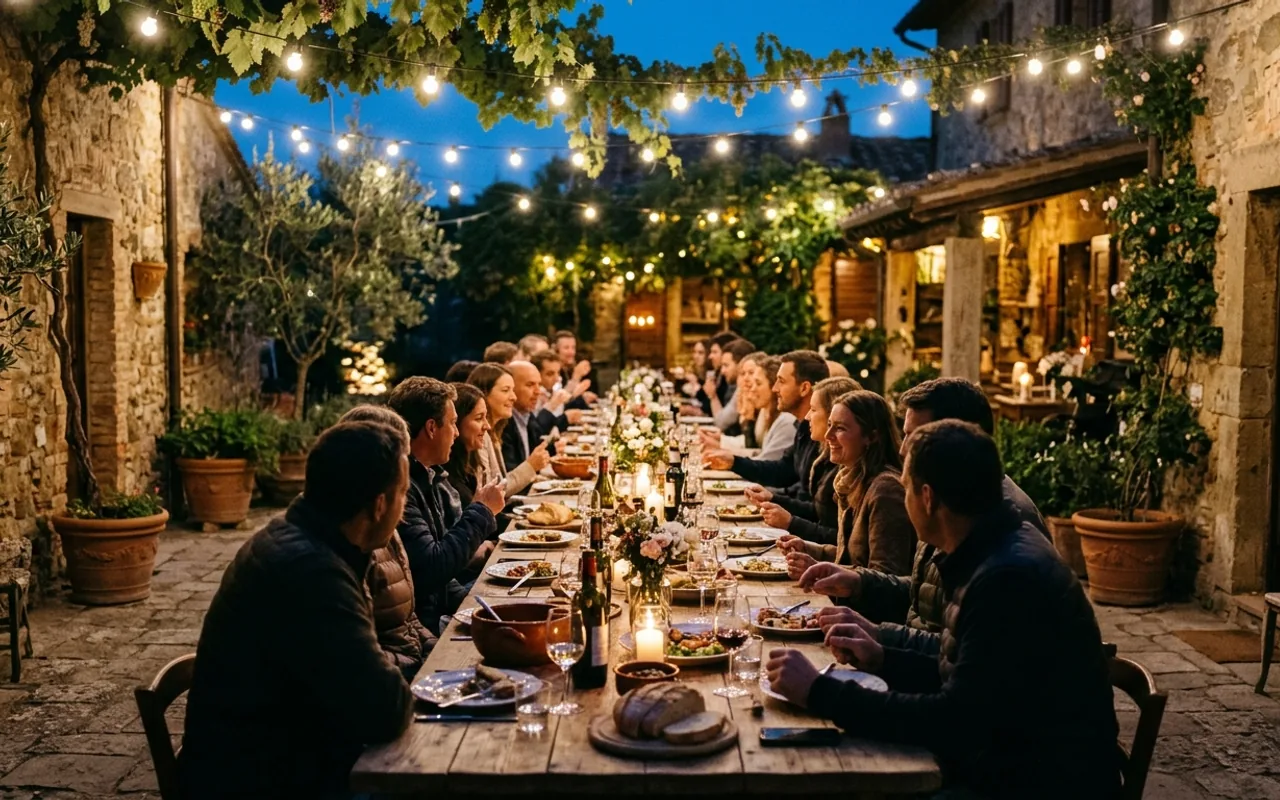
Discover concerts, nightlife, dining, culture and events in Hepberg.
The newly uncovered frescoes in the half-dome of the apse, covered by a starry sky, show a enthroned Christ in the mandorla, his right hand raised in blessing, his left holding the open book (Majestas Domini); Christ’s face is no longer recognizable. Around him, in framed medallions, are the symbols of the four Evangelists; two have survived: on the left, a lion (Mark), on the right, an ox (Luke), both winged and holding a scroll (according to Rev. 4:6–8). A painted geometric frieze separates the half-dome from the surrounding pictorial zone, continuing the impost cornice. On the front wall stands Christ with his right hand raised, St. Peter on the left, St. Paul on the right. To the left of them is a kneeling saint, perhaps the patron of this church, St. Oswald; however, his attributes are no longer recognizable. Beside him stands a female saint, perhaps the king’s daughter whom St. Oswald (603–642, King of Northumbria) had courted and with whom he had lived a devoutly moderate life. The fresco, like the church’s dedication to Oswald, is thus likely a testament to the veneration of the saint that spread in the Middle Ages, also in Bavaria, where he was regarded as the patron saint of reapers and livestock and in some places also as an auxiliary saint in times of need. The two saints on the south wall can no longer be identified. The date is likely the early 14th century. At the chancel entrance, on both sides, are two frescoes (c. 1400): on the left a scene with a bishop, on the right an Annunciation scene. The window in the apse and the front one of the two small windo
[Parking options](https://www.dollnstein.de/parken/) [3D video of the route](https://youtu.be/N_gqq9VyeRc) The starting point is the market square; from there, continue to Wellheimer Straße. Turn into Moosweg, then turn into Sonnleite. In the Urdonau Valley, along “Am Gänsbuck” below the juniper heath with rugged limestone cliffs, continue to the ski area. On the forest path, through the Dollnstein Forest, the route leads to Ried. Here we cross the cycle path and walk up to the edge of the forest. Along the edge of the Beixenhart nature forest reserve, we hike toward Dollnstein. At Rieder Weiher and the children’s playground, we cross the district road and continue parallel to the “Moosgraben” until the entrance to the village. From here, return to the starting point along the familiar route.
The origins of the castle complex probably date back to the 13th century. The name of the village is first mentioned in the land register of Duke Ludwig the Bearded of Ingolstadt (1413–1447). From 1524 to 1692, three farms and one Hube in Hepberg were incorporated into the manorial estate of Lenting. From 1692, the estates — now as an independent manorial estate — belonged for a time to the Bartholomäer Institute in Ingolstadt. Around 1728, the lord of the manor, Baron von Lichtenau, had all the castle and farm buildings rebuilt. In 1740, Hepberg, together with the manorial estate of Lenting, came into the possession of Baron Felix Joseph Müller von Gnadenegg, whose family coat of arms — a half mill wheel — still forms part of the municipal coat of arms today. In 1768, Maximilian Anton Nepomuk Edler von Stubenrauch bought the manorial estates of Lenting and Hepberg from the Müller heirs. At his instigation, a “courtly, graciously privileged real rural school institute” was established in Hepberg Castle in 1771, which at times took in 200 to 250 poor and neglected pupils from all over Bavaria. Extensive construction work was carried out for this purpose, and a water pipeline with wooden pipes was also laid from Stammham. The children, aged 7 to 14, had only one hour of lessons a day and had to work ten hours; many died of illness and malnutrition, and some ran away from the school. By 1778 the experiment had definitively failed, and the school was closed. Until the abolition of patrimonial jurisdiction in 1840, the manorial estate remained linked with Lenting through person
Discover 3 curated Community & Social events and highlights in Hepberg on Viventii with times, venues, and tickets. Current highlights include Old Church - former manorial and Expositur Church of St. Oswald, Catholic Church St. Oswald Hepberg, Hepberg Castle.
Viventii currently lists 3 public events, concerts, parties, cultural happenings, and local spots in Hepberg, including Old Church - former manorial and Expositur Church of St. Oswald, Catholic Church St. Oswald Hepberg, Hepberg Castle.
Use Viventii's curated Today, Tonight, Weekend, This Week, Leisure, and Places guides for Hepberg.
Yes, browse free admission events at /en/cities/Hepberg/free and 0% fee tickets at /en/cities/Hepberg/tickets.