Discover concerts, nightlife, dining, culture and events in Leipzig.
Knowledgeable guides provide interesting facts and background information about the animal world.
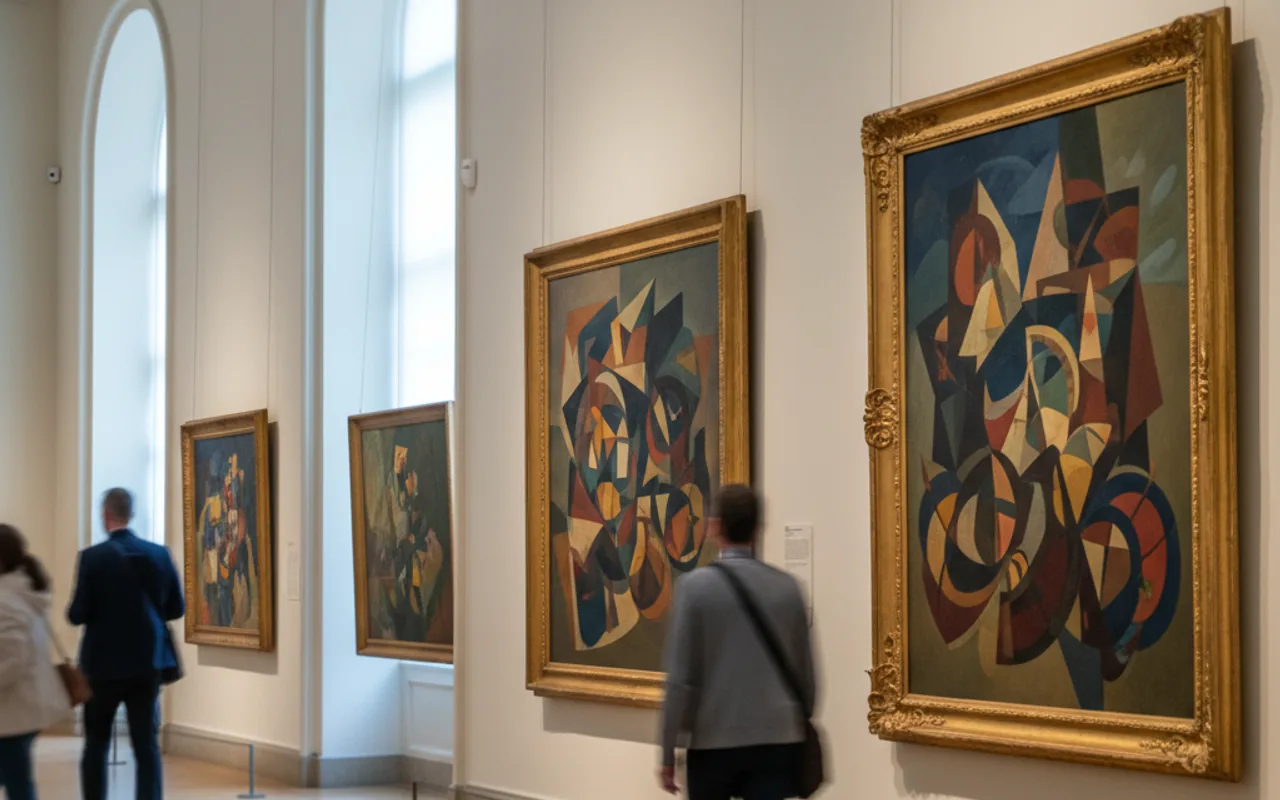
The exhibition combines visual, olfactory, and acoustic impressions into a holistic experience.
Visitors experience how art shapes and transforms spaces. Nina Hahn also interprets into German Sign Language.
Here there is space for creative crafting and drawing for everyone aged 12 and up with Margareta Behr.
The romantic opera about love and fate in Paris delights with unforgettable melodies.
In an intimate atmosphere, listeners can experience classical or contemporary works up close.
A fascinating look at the craftsmanship behind opera production.
In one hour, visitors can discover masterpieces and gain insights into various art periods.
reduced to the essentials so that great emotions and great music can take center stage. An emotional story that goes straight to the heart.
This interactive event combines music and movement in a relaxed atmosphere.
Visitors gain insights into the creation of art and can exchange ideas with the artists Leon Kahane and Fabian Bechtle.
Visitors experience how different artistic positions exchange ideas with one another and enter into dialogue.
The audience experiences the familiar story in a new theatrical interpretation.
The audience experiences one of the most beloved operas in music history in a fresh interpretation.
Experienced guides share interesting facts about the inhabitants and their special features.
The audience experiences a dynamic mix of poetry, humor, and artistic expression.
The event combines a visit to the animals with a Christmas atmosphere.
Visitors learn more about the different species of monkeys and their conservation.
The audience can look forward to a Christmas-inspired production with musical elements.
The audience immerses itself in the world beneath the sea with music, dance, and visual effects.
BAUHAUS architecture: After the First World War, the housing situation in Leipzig was critical - there was a shortage of 13,000 apartments for 26,000 people looking for accommodation. The architect Hubert Ritter combined these new requirements in his municipal circular development in Lößnig, which lasted from 1929 to 1930. He was inspired by buildings from the Neolithic period, which were arranged in circular structures. The so-called Rundling was built in the Bauhaus style and was Ritter's vision of modern living. The circular structure bundles the settlement life and emphasizes the community character of the residential area. The cross-shaped neighborhood streets cutting through the rings are visual axes, structuring elements and entrances at the same time. He used the rising ground formation for a ring development and had the inner ring built one storey higher. In total, the roundel consists of 24 houses and has a diameter of 300 meters on the outer ring. The spacing between the houses in the middle ring was left wider in order to create visual connections from all points. The Rundling houses 609 apartments in different sizes and layouts. Each one is designed to ensure optimal lighting conditions. Great importance was also attached to the green spaces around the buildings. Originally there was even a paddling pool in the middle of the Rundling, but today roses are planted there.
The boat rental in the wildlife park is located in the building of the former Aegir Canoe Club e. V. and picks up on over 100 years of water tourism tradition. The current cultural monument is being gradually renovated in line with the historical model and adapted to the appearance of the house from 1921. The offer includes guided motorboat tours with drinks on board as well as the rental of 1 to 3-seater kayaks, 2 to 4-seater canoes and rowing boats. Thanks to its quiet location in the floodplain forest, the boathouse is an ideal destination for exploring nature and waters via the waterways, and the boat rental is also equipped with a barbecue area - perfect after your canoe or motorboat trip, as well as for celebrations and family outings. The rental is open depending on the weather and high water Advance bookings for rental boats (kayaks, canoes, rowing boats) are not possible.
The Fockeberg in the Südvorstadt district is the second highest point in the city of Leipzig. Its origins go back to the bombing of Leipzig during the Second World War. The rubble was transported from the city to the southern suburbs to today's Fockeberg square via a rubble railway. In the mid-1950s, the material was removed again for the construction of Leipzig's central stadium, so that the height of the Fockeberg decreased considerably. Over the years, wild bushes and trees grew on the rubble and greened the hill. At the beginning of the 1980s, the Fockeberg was finally given a more targeted greening. Every year, many different events take place on the Fockeberg, e.g. the "Prix de Tacot" soapbox race and the Fockeberg time trial. In addition, the two neighboring parishes of St. Betlehem and St. Hedwig organize an annual ecumenical church service;
The Löffelfamilie is an inseparable part of Leipzig's Karl-Liebknecht-Straße. Today, there is a beer garden under the neon sign and flea markets and the Feinkost summer cinema are held regularly. The site of today's delicatessen was opened as a brewery in the late 19th century and later gave way to a food production plant. After the Second World War, the canned food production of the state-owned company Feinkost moved into the premises, marking the birth of the iconic spoon family. As part of the GDR party initiative "Leipzig - City of Water and Light", this neon sign, along with many other neon signs in the city, is now a listed cultural asset and a fixture in the hearts of Leipzig residents.
The festival is a partner of the Leipzig Card / Leipzig Regio Card. You will find your benefits described under "General information/more price info". First-class vocal music on stage! The week-long a cappella festival brings together vocal musicians and ensembles from all over the world every year to celebrate this special kind of music. The festival takes place at the end of April/beginning of May and offers a stage to established musicians and newcomers. Many concerts and various special events take place as part of the festival.
In 1995 and 1996, a new literary center, the Haus des Buches, was built on behalf of the Börsenverein des Deutschen Buchhandels (German Publishers and Booksellers Association) in place of the bookseller's house, which was destroyed in the Second World War, according to designs by the planning consortium Angela Wandelt and HPP Leipzig. The red brick ensemble is one of the most remarkable new buildings of recent years, and its construction is a continuation of the tradition of the city's Graphic Quarter. Consisting of a comb building open to the south, a seven-storey tower and an old part of the building, the ensemble is connected by a glazed cube. Two atriums are concealed behind the glazing in the direction of Prager Strasse, one of which houses the metal installation "Letter Field". On Gerichtsweg, in front of the building complex, you will find a column of letters bearing the names of former Leipzig publishers.
The Mendelssohn House is with the museum and the Sunday concerts in the Mendelssohn House Partner of the Leipzig Card/ Leipzig Regio Card. The benefits are described under "Good to know/price information" The Mendelssohn House is the only surviving home of the composer Felix Mendelssohn Bartholdy, who died in Leipzig in 1847. It is now used as a music salon and is also the world's only Mendelssohn museum. Visitors to the museum can access Felix Mendelssohn Bartholdy's apartment via the preserved historic staircase, which has been restored to its original design as it was during the composer's lifetime. The composer's study, where works such as the oratorio Elijah were written, the magnificent music salon, where numerous prominent visitors such as Richard Wagner, Robert and Clara Schumann and Hans Christian Andersen frequented and where a concert is held every Sunday today, the furniture from the family estate, letters and sheet music, watercolors by Mendelssohn and extensive information on the life and work of the artist make this authentic place an unforgettable experience. Thanks to the audio guides in German, in German for children and in plain language, visitors can delve even deeper into Mendelssohn's world. The museum in the Mendelssohn House also offers various activities for children, including many small events in the Mendelssohn House coach house during the summer and winter vacations as well as educational programs for kindergarten groups and school classes. More about the Mendelssohn House and the musician and composer Felix Mendelssohn
The Europahaus was built between 1928 and 1929 as the second high-rise building after the Krochhaus. The plans for it were developed by Leipzig architect Otto Paul Burghardt. Unlike the Krochhaus, it is not based on historical predecessors, but is entirely modernist. The monumentality that was practiced in America was dispensed with. It was important to the architect that the high-rise fitted into Leipzig's cityscape. With a height of 54 meters, the Europahaus only towers over its predecessor by 13 meters. It houses a 13-storey tower-like central building and two seven-storey side wings. The façade is clad with shell limestone panels. In 1965, the entrance hall was decorated with arrowhead arcades during a renovation. However, the gastronomic use of the roof terrace was lost during the conversion. The building was not decorated with ornaments or other embellishments. The only element of embellishment is the horizontal lettering "Europahaus" between the sixth and seventh floors. The rows of small windows also serve a functional purpose. Otherwise, only the pillars between the windows emphasize the vertical orientation.
The Gewandhaus is located on Augustusplatz opposite Leipzig Opera House and is home to the famous Leipzig Gewandhaus Orchestra. The Gewandhaus in Leipzig hosts around 800 events a year. The Gewandhausorchester performs its symphony concerts here in the Great Hall, while the Gewandhaus Chamber Music presents itself in the somewhat smaller Mendelssohn Hall. Concerts by well-known musical greats take place here regularly and it is a popular location for lectures and congresses. The large hall seats a total of 1,900 visitors and is home to the majestic Schuke organ. The Gewandhaus is also part of the Leipzig Music Trail and the Leipzig Music Wheel as well as the venue for the annual Lachmesse. To find out more about the Gewandhaus with the Gewandhaus Orchestra and famous Leipzig composers such as Bach and Mendelssohn, it is worth listening to the [Podcast "Welcome to Leipzig"](https://www.leipzig.travel/podcast-willkommen-in-leipzig).
City-Hochhaus, Uniriese, Weisheitszahn, Panorama-Tower: Leipzig's tallest office building and landmark has many names. At 142.5 meters it is the second tallest skyscraper in the new federal states. A must for all visitors to Leipzig is the viewing platform on the 31st floor. From here, you can enjoy a wonderful panoramic view of the city - even far beyond the city limits in good weather. The best part: Not only is there a fantastic view over the skyline of the trade fair city, but also the Panorama Tower restaurant "[Plate of Art](https://www.leipzig.travel/gastro/panorama-tower-restaurant)" with delicious specialties. Admission to the viewing platform is €5.00 per person.
Klassik für Mitteldeutschland comes from Leipzig. In the middle of the city, right next to the Gewandhaus and City-Hochhaus Leipzig Klassik für Mitteldeutschland comes from Leipzig. The MDR choirs and orchestra have their rehearsal, concert and studio rooms in the MDR Studio on Augustusplatz in the heart of the city, right next to the Gewandhaus and City-Hochhaus. The three ensembles, MDR-SINFONIEORCHESTER, MDR-RUNDFUNKCHOR and MDR-KINDERCHOR, perform their concerts primarily in Leipzig and in the broadcasting region. The musicians are also regularly involved in CD, radio and TV productions. The MDR-MUSIKSOMMER, a three-state classical music festival that brings together stars, music, distinctive places and people in Saxony, Saxony-Anhalt and Thuringia, is also a permanent fixture.
The historic multi-level carousel is a special attraction at the Christmas market on Salzgässchen. The opening of the 100-year-old carousel was canceled in 2009 due to a fire. But just one year later, the carousel returned to its old familiar place in its original replica.
The house where Hanns Eisler was born is located at Hofmeisterstraße 14, which you will pass by if you are traveling on the Leipzig Music Wheel (stop 14). Johannes Eisler was born on July 6, 1898 as the son of the Austrian-Jewish philosopher Rudolf Eisler and the Saxon butcher's daughter Ida Maria Fischer at no. 14 of the former Gartenstraße (since 1905: Hofmeisterstraße) in Leipzig. The "mother city", as he called Leipzig, left its mark on him throughout his life. In Vienna, the "father city", to which the family returned in 1901, Eisler acquired his comprehensive humanistic education, was drafted in the First World War and wrote his first compositions. His lessons from 1919 to 1923 with Arnold Schönberg, the founder of the twelve-tone technique, had a particular influence on Eisler's compositional work. Eisler composed the GDR national anthem "Risen from the Ruins" in 1945. He also wrote Hollywood film music and was even nominated for an Oscar. Eisler also scored the DEFA feature film "Unser täglich Brot". He is one of the most important German-language composers of the 20th century.
As a traditional fairground, the site on Cottaweg serves the city of Leipzig as a venue for various events all year round. Among other things, the famous Leipzig Small Fair takes place here several times a year. Due to its area of 35,000 m² and excellent transport connections, the site with up to 1,000 parking spaces often also serves as a parking area for visitors to major events in the neighboring Red Bull Arena or the festival meadow in front of the stadium. Three times a year, the site itself is the venue for the traditional small fair, an amusement park with stalls and lottery booths as well as numerous carousels that guarantee adventure and fun.
Discover 36 leisure activities, outdoor spots, sports, museums, and workshops in Leipzig for today or this weekend. Current highlights include Tours in November, A scent, a color, a sound, Four Walls Full of Art.
Explore 36 leisure activities across outdoors, sports, exhibitions, workshops, and cinema in Leipzig, such as Tours in November, A scent, a color, a sound, Four Walls Full of Art.
Open our places and attractions guide at /en/cities/Leipzig/poi for opening hours and addresses.
Yes, visit /en/cities/Leipzig/kinder for curated kid-friendly outings and family workshops.