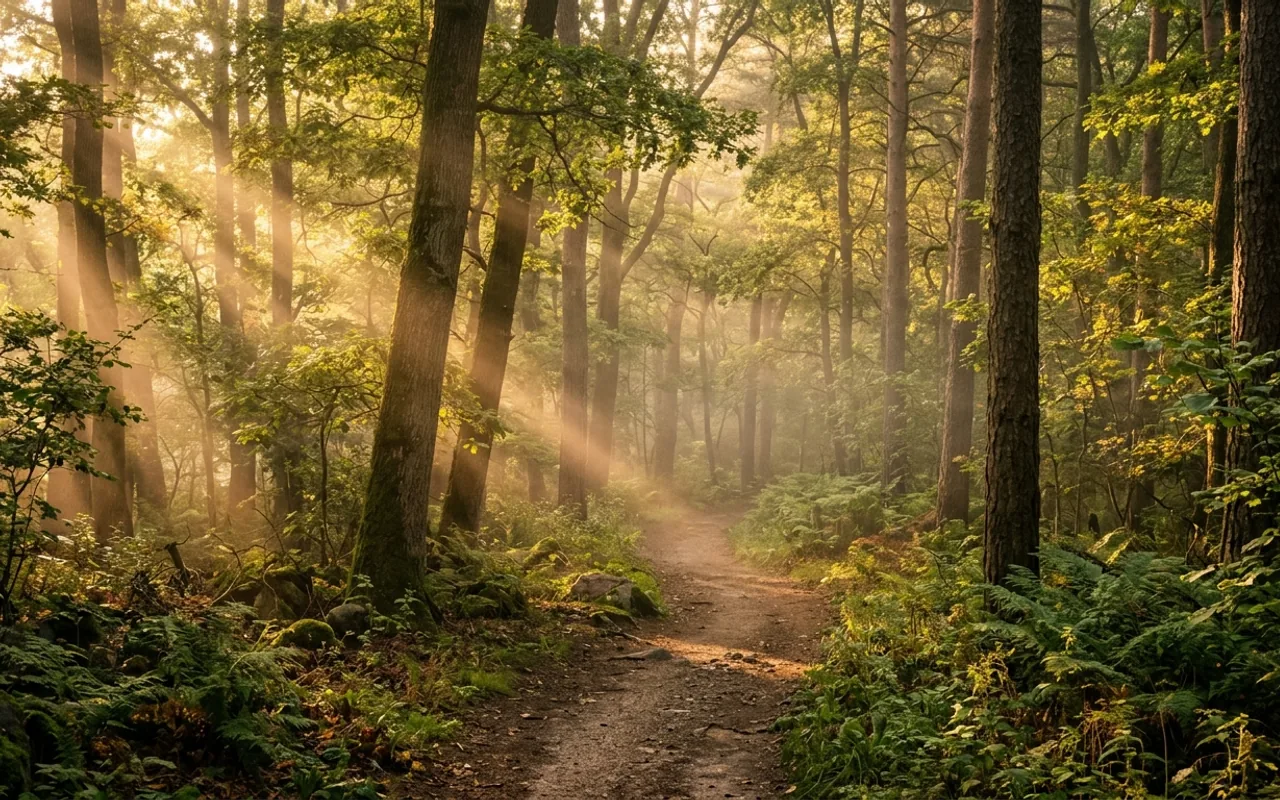
Discover concerts, nightlife, dining, culture and events in Wermsdorf.
As early as 360 years ago, the hunting-loving Elector George I considered building a lookout tower on the Collm, but it was not until 1851 that the construction of the Albert Tower was made possible thanks to donations from many nature and local history enthusiasts, and the foundation stone was laid on the Collm mountain summit. In April 1854, the 18-metre-high tower was opened for climbing. It was named after the then prince and duke, later King Albert of Saxony. On days with particularly good visibility, you can see from the platform not only the silhouette of Leipzig, around 60 km away, with the Monument to the Battle of the Nations and the university building, but also the ridge of the Erzgebirge, the peaks of the Lusatian Mountains, Petersberg near Halle and Augustusburg Castle. Many people hike to the Collm at any time of year to enjoy the fabulous view, including of the surrounding area. Visitors have to climb 99 steps to reach the viewing platform. Since 1993, the panoramic view has also been possible through a stationary telescope. On the platform of the observation tower stands a granite column from the "Nagel triangulation" of 1865, the most accurate, traditional degree measurement in the country. The well-known "measuring table sheets" were created on its basis until very recently. The inscription reads: "Königlich sächsische Station Collm der Mitteleuropäischen Gradmessung". The Albert Tower is now owned by the municipality of Wermsdorf and is accessible to hikers and day trippers from April to October.
This technical monument will delight insiders. The trestle windmill, which has been a technical monument since 1991, is located at Radegaster Weg 7, a few hundred meters after the village exit sign. It is called a trestle windmill because its foundation consists of a trestle. The trunnion extends from this as a fixed element to the grinding beam, which is the supporting element of the upper part of the mill. The mill rotated on the grinding beam until its restoration, which took place before and after the fall of the Berlin Wall. Herbert Weber owned the mill from 1973 to 1987. Nowadays, he gives guided tours of the technical monument. According to him, the mill was built between 1838 and 1841. It was mainly built in the summer months, as the winters used to be harsher. The mill and millyard are located on a small hill and cover an area of 600 m². The builder, a miller and farmer named Ebert, sold the mill to Robert Willig in 1895. He was the grandfather of Mrs. Weber, née Willig. Alfred Willig, his son and father of Mrs. Elfriede, took over the mill in 1925. In 1927, the mill was converted to electric drive. In that year, the overhead power line was laid from Luppa to Radegast. It made sense to provide the mill with electricity in this context. Until then, wind had been the only source of power. When there was little wind, the miller had to work into the night. However, wind was still used together with electricity to drive the mill blades, as this allowed electrical energy to be used sparingly. The electric motor had 10 HP. With the electrification, a roller mill and a s
Discover 2 curated Nature & Outdoor events and highlights in Wermsdorf on Viventii with times, venues, and tickets. Current highlights include Albert Tower on the Collm, Luppa windmill.
Viventii currently lists 2 public events, concerts, parties, cultural happenings, and local spots in Wermsdorf, including Albert Tower on the Collm, Luppa windmill.
Use Viventii's curated Today, Tonight, Weekend, This Week, Leisure, and Places guides for Wermsdorf.
Yes, browse free admission events at /en/cities/Wermsdorf/free and 0% fee tickets at /en/cities/Wermsdorf/tickets.